DbState
Menu

Review-first database state management

Understand the change before anything is executed.

DbState inspects, compares, captures, and prepares database state for review. It keeps database execution and Git history under the team's control.

No direct database apply. No generated SQL execution. No automatic Git commits.

Operating model

Explicit operations. Separate boundaries.

DbState separates reading database state, writing repository files, comparing desired state, preparing release handoff artifacts, and executing database changes.

Database reads are distinct from repository writes

Repository writes occur through explicit workflows

Comparison does not mutate PostgreSQL

Release Plans do not execute SQL

Review-only artifacts remain external handoff inputs

Git operations remain outside automatic DbState behavior

Repository to Database review path

read-only until handoff
  1. source database

    PostgreSQL Database

    Target database metadata and selected rows are read by DbState.

  2. read

    Database Inspection

    Inspection gathers state without mutating PostgreSQL.

  3. compare

    State Comparison

    Repository desired state is compared with database state.

  4. review

    Object Diff / Data Diff

    Differences are exposed for human inspection.

  5. select

    Release Plan

    Supported candidates can be selected for a handoff plan.

  6. prepare

    Review-only Artifact

    Artifacts are prepared for review, not executed by DbState.

  7. controlled handoff

    External Database Release Process

    Approved SQL is executed outside DbState.
Database to Repository capture path

explicit repository write
  1. source

    PostgreSQL Database

  2. explicit capture

    Repository-managed files

Database execution

Database execution stays outside DbState.

DbState helps teams understand and prepare database changes. It does not take over the point where approved SQL is executed against a database.

DbState boundary ends before database execution.

DbState does not validate every operational risk in SQL that users execute outside the product. Existing database release controls remain necessary.

  • DbState does not directly apply generated SQL
  • DbState does not execute review-only release artifacts
  • Repository-to-Database comparison is read-only
  • Users review approved SQL through their existing database release process
  • The database remains unchanged unless a user acts outside DbState

Repository writes

Repository writes are explicit.

Database-to-Repository workflows can write repository-managed state, but only through intentional user workflows. Capture changes do not mutate PostgreSQL.

DbState requires an explicit workflow before writing repository-managed state.

Repository write targets

controlled folders
  • Database object files
  • Reference-data configuration
  • Reference-data YAML
  • Review-only release artifacts

Write boundary

  • Writes occur only through an explicit user workflow
  • Selection and confirmation are required where implemented
  • DbState writes only under controlled repository folders
  • Repository writes do not imply Git staging or Git history changes
  • No PostgreSQL mutation occurs during capture

Git control

Git remains user-controlled.

DbState may show local Git workflow visibility, but users remain responsible for Git commands and repository history.

local Git visibility only

Current Private Beta does not provide hosted collaboration, shared Git workflows, or server-side repository management.

DbState does not automatically

  • Add
  • Commit
  • Push
  • Pull
  • Fetch
  • Tag
  • Rewrite history
  • Create branches
  • Merge branches

Manual review

Not every difference should become generated SQL.

DbState does not pretend that every schema difference has a universally safe automated resolution. Manual review is an explicit outcome, not a hidden failure.

manual-review case

Destructive SQL is not generated by default. Changed or database-only objects may remain manual-review cases.

Capability scope

Unsupported PostgreSQL object types remain outside automatic artifact preparation. Review current capability scope on the Product page.

Destructive or sensitive examples

  • Dropping tables
  • Dropping columns
  • Dropping constraints
  • Dropping functions
  • Revoking grants
  • Ownership changes
  • Default privilege changes
  • Row-level security mode changes

This page is not an exhaustive release-artifact support matrix.

Reference data

Reference-data comparison is conservative.

Reference-data workflows start with explicit table selection and comparison rules. Repository-to-Database reference-data comparison remains read-only in the current Private Beta.

  • Users explicitly choose which tables are reference data
  • Key columns identify rows
  • Ignored columns do not create differences
  • Masked columns remain protected
  • Repository-to-Database comparison is read-only
  • The current Private Beta does not automatically generate INSERT, UPDATE, DELETE, or MERGE for reference-data differences
  • Database-only rows remain manual-review cases

Credentials

Database passwords are not stored.

DbState's local workflow keeps credential handling narrow. Saved connection profiles may retain non-secret connection settings, but PostgreSQL passwords are entered when needed.

Local workflows reduce the need to transmit database credentials to a hosted DbState service.

Credential boundary

no stored PostgreSQL passwords
  • Saved connection profiles may retain non-secret connection settings.
  • PostgreSQL passwords are entered when needed.
  • DbState does not store PostgreSQL passwords.
  • Website screenshots and documentation must not expose credentials.

Release handoff

Artifacts are prepared for review, not blind execution.

The Release Plan review surface helps teams inspect selected candidates before any database execution occurs outside DbState.

  1. 01Compare repository desired state with PostgreSQL
  2. 02Inspect Object Diff or Data Diff
  3. 03Select supported release candidates
  4. 04Build a Release Plan
  5. 05Prepare supported review-only artifacts
  6. 06Review the artifact
  7. 07Execute approved SQL outside DbState using the team's normal release process
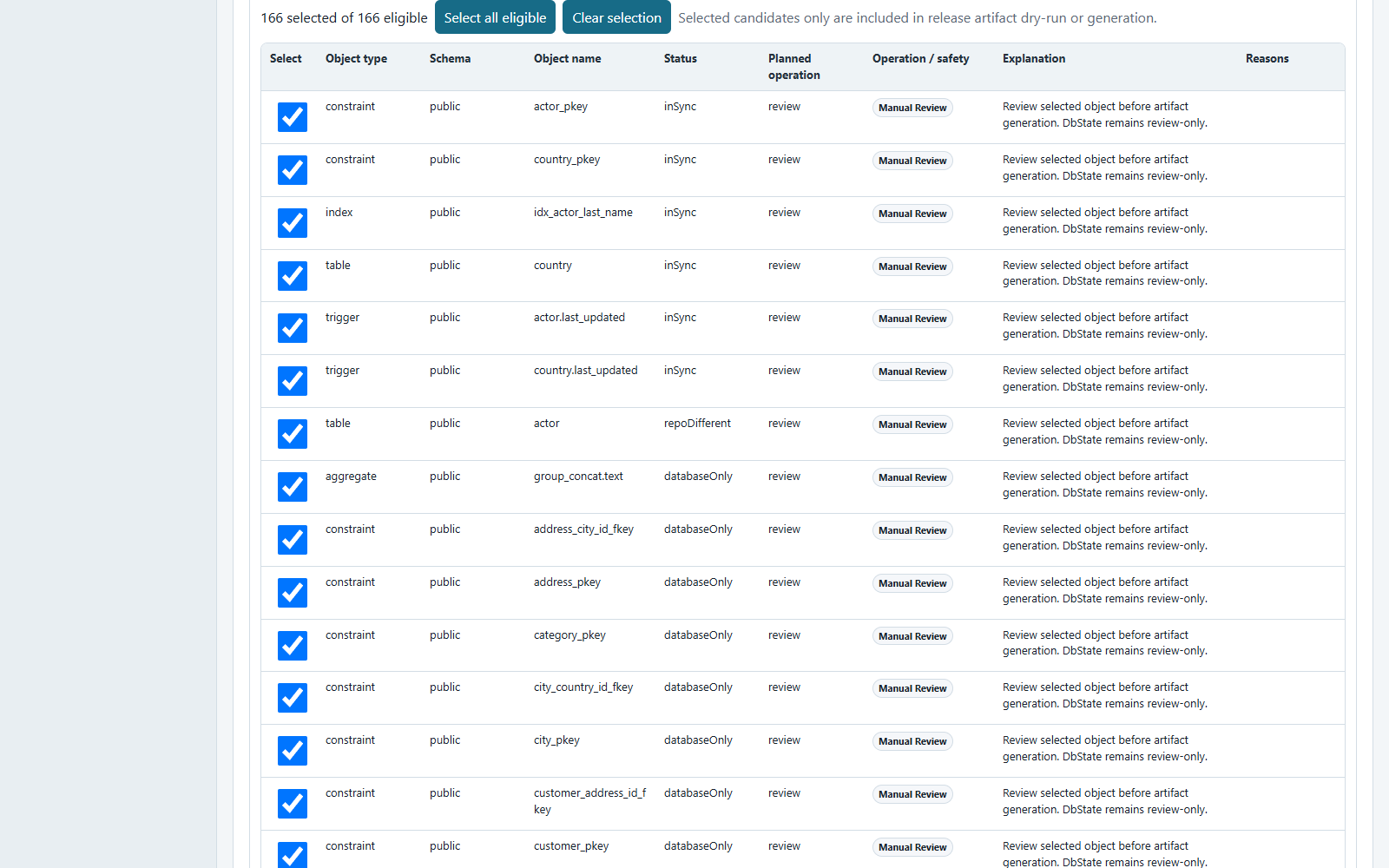
DbState Release Plan screen showing selected schema release candidates, manual review labels, and review-only candidate explanations.

Release Plan

Select supported release candidates and review the planned handoff before any database execution occurs outside DbState.

Open full-size Release Plan screenshot

Limits of review

Review-first does not mean risk-free.

DbState improves visibility, review evidence, and control boundaries, but human review and operational release controls remain necessary.

DbState is a database state management and review tool. It is not a substitute for engineering judgment, database release process, or operational controls.

DbState does not guarantee

  • Error-free SQL
  • Zero production incidents
  • Complete detection of every destructive consequence
  • Automatic rollback
  • Transactional deployment
  • Regulatory compliance
  • Complete separation of duties
  • Approval enforcement
  • A complete hosted audit trail
  • Correctness of externally modified repository files
  • Correctness of SQL executed outside DbState

Private Beta scope

Current Private Beta safety scope.

The current safety model is scoped to local PostgreSQL workflows where repository state, database comparison, release handoff, and Git history remain explicit.

Included

current scope
  • Local Windows workflow
  • PostgreSQL database inspection
  • Explicit repository capture
  • Read-only Repository-to-Database comparison
  • Object Diff
  • Data Diff
  • Release Plans
  • Review-only release artifacts
  • User-controlled Git operations
  • No stored PostgreSQL passwords

Not included

outside current beta
  • Direct database apply
  • Generated SQL execution
  • Automatic Git operations
  • Hosted collaboration
  • Shared server workspaces
  • Organization approval workflows
  • Hosted policy enforcement
  • Hosted audit trails
  • Automatic rollback
  • Database engines other than PostgreSQL

Private Beta

Evaluate the review boundaries with a real PostgreSQL workflow.

DbState Private Beta is intended for developers, database engineers, and technical teams that want database state in Git without handing execution control to the tool.

PostgreSQLWindowsLocal workflowGit repository requiredReview-only artifactsAccess by request